


Advanced Lightning Air Terminals & Monitoring Systems
Lightning Air Terminals protect structures against physical destruction by safely capturing direct lightning strikes, conducting the current down low-impedance pathways, and dissipating the high-voltage energy into the earth grounding grid.
Dhruva Technologies offers the industry's most advanced air terminal technologies — from proactive Early Streamer Emission (ESE) air terminals to conventional Franklin rods and digital lightning strike counters.
Static Early Streamer Emitting Terminal Protec® ESE
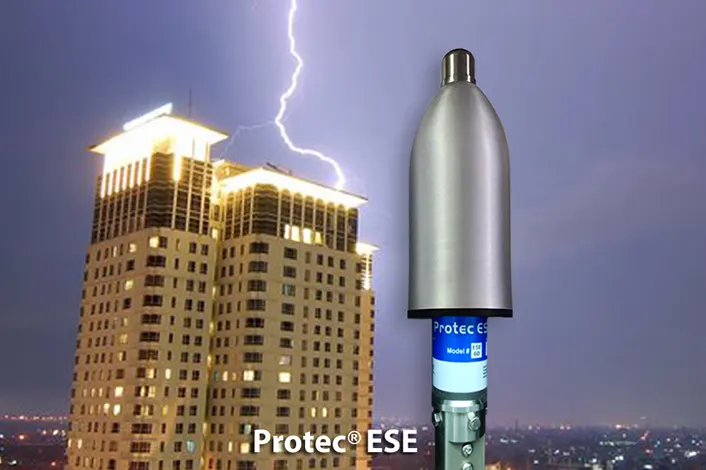 Protec® ESE Static Terminal
Designed to collect ground charges during thunderstorm buildup and emit strong, consistent upward streamers to intercept downward lightning leaders earlier than conventional rods.
Key Features:
- Complies with NFC 17-102 & UNE 21186 international standards
- Tested to withstand multiple 40kA high-voltage impulses
- High-quality anti-corrosive & conductive protective coating
- Low wind resistance and lightweight design
- Available with 20µs, 40µs, and 60µs time advance (Δt)
- 5 Years replacement warranty
Electronic Early Streamer Emitting Terminal FlashCaptor®
 FlashCaptor® Electronic ESE Terminal
Equipped with a stepped electrostatic accumulator, multiple spark gaps, and an electronic upward streamer generator housed in a watertight AISI-316 stainless steel casing.
Key Features:
- Triple insulation system for extreme weather environments
- Wholly manufactured from Marine-Grade AISI-316 Stainless Steel
- Shielded electronic high-voltage impulse emitter
- Zero external power supply required (100% autonomous)
- Dimensions: 60mm Body Dia · 470mm Length · 2.43 kg Weight
Protec® FR- Franklin Rod (Conventional Lightning Rod)
Lightning rods were originally developed by Benjamin Franklin in eighteenth century. These are metal rods installed over a structure as preferred points for a lightning strike. These terminals are connected to a network of horizontal and vertical conductors that are terminated to earthing terminals. The network of rods, conductors and earth terminals covers the protected structure in a Faraday Cage.
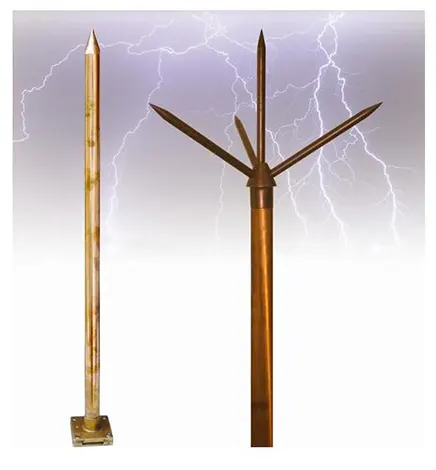 Protec® FR Franklin Air Terminal
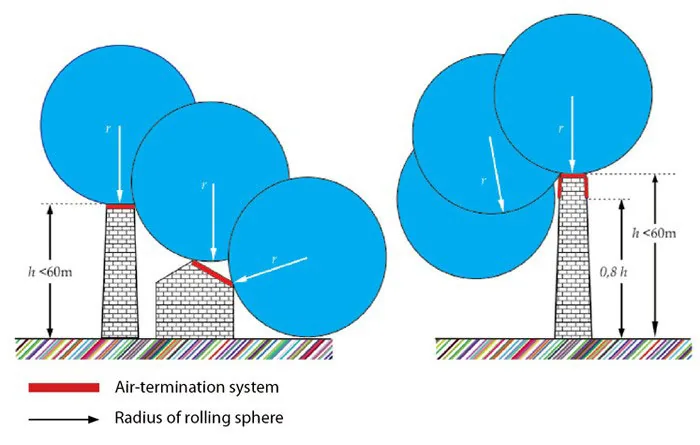 Rolling Sphere Protected Volume Method
Features
- Tower type constructions with small area to protect.
- Mosque Minaret, Light House, Sentry Box etc.
- Special Point Protection in Faraday Caged construction
- Chimney projections, equipment especially on flat roofs, elevator towers etc
Protec® LEC - Lightning Event Counter
Protec LEC have been designed to monitor lightning discharge on a lightning protection system. It consists of a rectifier, capacitor and an electronic switch connected to a mechanical counting relay. It is totally sealed in a weather proof box. The complete assembly is housed in an elegant alloy casting. A suitable window permits easy reading of the 6-digit counter. The design of the circuit ensures that the counting relay is not energized for low lightning current impulses.
No risk of internal arcing and explosion in the event of a short circuit.
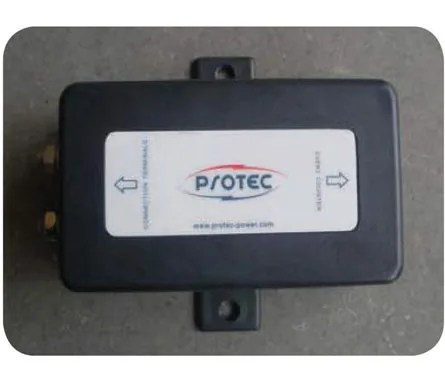 Protec® LEC Lightning Strike Event Counter
Features
- Internally protected
- Six digits counter
- Voltage drop across the shunt triggers the counter
- Weather resistant
- Compliance to IEC 62305
- IP67 enclosure
Protec® ESE Tester
Dhruva Technologies has designed this unique remote testing tool for ESE Terminal. The Pro ESE Tester is capable of operating from a distance of 100mtrs to test the serviceability of the ESE Air Terminal and it’s connectivity to the lightning down conductor. It has 2 parts i.e. Part #1 (Receiver - Rx Unit) and Part #2 (Transmitter - Tx Unit)
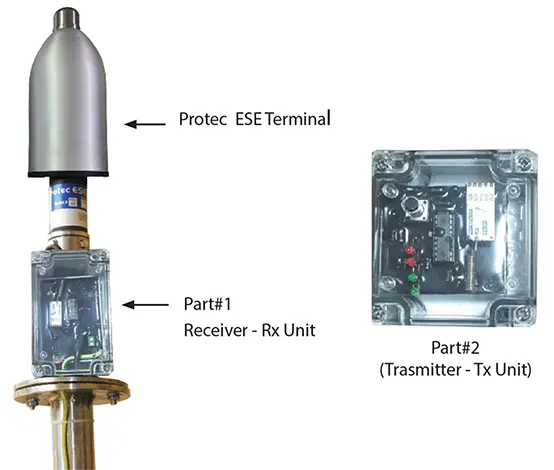 Protec® 100m Remote ESE Tester (Tx & Rx System)
General Features
- Operating Temp. Range = -5°C to 50°C
- Storage Temp. Range = -10°C to +55°C
- Frequency of Operation of Rx/tx unit = 2.4 Ghz
- ESE Tester shall not affect or get affected by operation of V/UHF transmission in vicinity of it.
- Receiver (Rx Unit) shall comply IP66 or better.
- Solar panel can be joint / provided for charge to battery but solar panel is not recommended for battery use of item.
Part #1 Receiver (Rx Unit) in a transparent enclosure is a Transreceiver unit. It receives the test signal, evaluates the functionality of system and transmits the signal. Rx Unit has one black detection wire and one green/Yellow ground wire. It is installed at the ESE Terminal part. It has Red indicator and has already been powered “ON” with an internal long life battery.
Part #2 Transmitter (Tx Unit) is a ESE testing - Tx unit. The unit sends a signal to the Rx and Rx starts the evaluation and sends the response to the Tx unit. The Tx unit has indication LED’s on the panel (Good, Fault & Low Battery). One Tx unit can work with paired Rx units. It has an ON/OFF button to operate when in use.